Forex Trading for Beginners in 2026
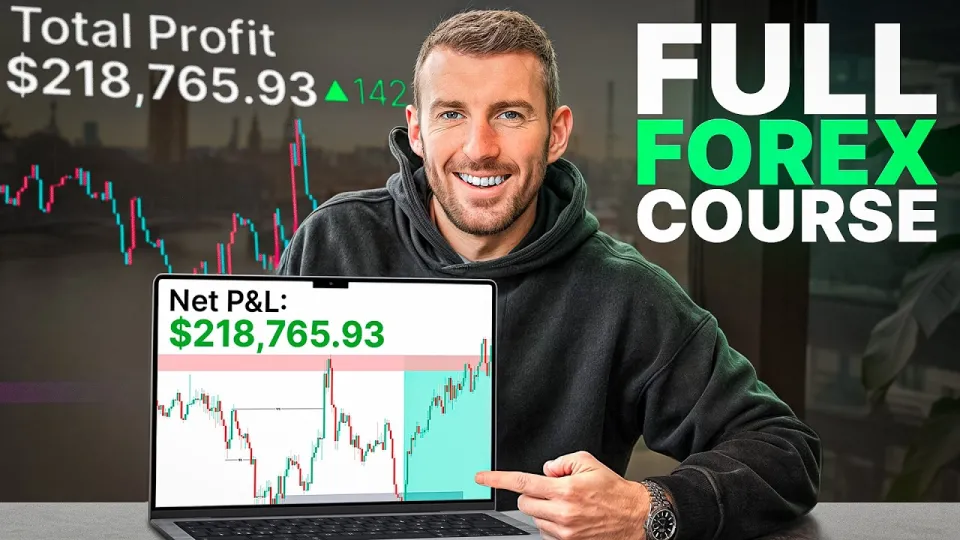
Video: Beginners Guide To Forex Trading In 2026 (+3 hours)
Want articles like this for your own video to promote it on YouTube and Google? Order them through the Telegram bot @sat_sit_bot. It writes articles around your video, embeds the video and publishes them on popular niche websites (no ads). Free trial — 50 articles.
· based on the channel Matt Donlevey - Photon Trading
Forex trading for beginners in 2026 means learning how currency prices actually move before choosing a strategy: quotes come from a decentralized over-the-counter market, profit is the difference between entry and exit, and survival depends on position sizing and costs rather than on chart patterns. A free structured starting point is the Photon Trading beginner course and cheatsheets, which covers the same ground as the long-form guide below.
What forex trading actually is and how money is made in it
Forex is the exchange of one currency for another at an agreed rate, and every trade is a bet on the relative strength of two economies rather than on a single asset. Currencies are quoted in pairs such as EUR/USD, where the first currency is the base and the second is the quote; a price of 1.0850 means one euro buys 1.0850 US dollars.
The retail market is decentralized. There is no single exchange where all orders meet; banks, brokers and liquidity providers quote prices over the counter, and your broker passes your order into that flow. That structure explains why spreads widen around news releases and why the same pair can show slightly different prices at different brokers.
Profit comes from three mechanics:
- Direction: buying a pair (long) profits if the base currency strengthens; selling (short) profits if it weakens.
- Leverage: brokers let you control a position larger than your deposit, which magnifies both gains and losses.
- Carry: holding a position overnight earns or pays the interest rate differential between the two currencies, credited or debited as swap.
A standard lot is 100,000 units of the base currency, a mini lot is 10,000 and a micro lot is 1,000. On EUR/USD, one pip on a standard lot is roughly 10 dollars, on a mini lot about 1 dollar and on a micro lot about 10 cents. Those numbers are the foundation of every position-size calculation later in the process.
Why technical analysis alone fails and what replaces it
Shapes on a chart do not explain why price moves; order flow does, and that is the core argument behind the Photon Trading approach. Triangles, flags and head-and-shoulders patterns describe the past without describing the participants, so a strategy built only on geometry has no reason to keep working once market conditions change.
The alternative is to study the mechanics underneath the chart: who is buying, who is selling, where resting orders sit and where stop losses are clustered. Auction market theory frames this simply. Price moves up and down searching for the level where buyers and sellers agree on value; when one side becomes aggressive, price has to travel until it finds the other side again.
Market microstructure supplies the vocabulary. The bid is the highest price a buyer will pay, the ask is the lowest price a seller will accept, and the spread is the gap between them, which is your first cost on every trade. An order book shows limit orders resting at each price, while order flow shows market orders hitting the bid or lifting the ask. Traders who read these dynamics stop asking what a pattern looks like and start asking what the pattern implies about unfilled orders.
This is also why the guide spends time on candlesticks before structure. A candle is a compressed record of a fight: open, close, high and low. A long wick tells you price was rejected at a level; a large body tells you one side dominated. Read as evidence of aggression rather than as a signal, candles become useful inputs instead of decoration.
The five building blocks of a systematic forex strategy
The Photon framework is assembled from five components that must agree before a trade is considered. Each answers a different question, and skipping one leaves a gap that shows up as inconsistent execution.
- Market structure. Structure is the sequence of swing highs and swing lows. An uptrend prints higher highs and higher lows, a downtrend prints lower highs and lower lows, and a range prints neither. The guide separates three structural states and stresses that you trade with the prevailing structure, not against it.
- Premium and discount. Once a range or leg is defined, its midpoint splits price into an expensive half and a cheap half. Buying in discount and selling in premium improves the risk-to-reward of every entry without changing the strategy.
- Multi-timeframe analysis. The higher timeframe sets direction, the middle timeframe defines the zone and the lower timeframe times the entry. Conflicting timeframes are the most common source of confused trades.
- Supply and demand. Zones where price left quickly, leaving unfilled orders behind, tend to attract price back. A valid zone is one that produced a strong departure and has not yet been revisited and consumed.
- Liquidity. Stop losses and pending orders cluster above swing highs and below swing lows. Price is often drawn to those pools before continuing, which is why entering exactly at an obvious high or low so often ends in a stop-out.
Putting it together means waiting for a liquidity sweep, a return into a supply or demand zone aligned with higher-timeframe direction, and a confirmation on the lower timeframe. Entries follow that sequence; trade management then decides where the stop sits, where partial profits are taken and whether the position is moved to break-even.
Money management, costs and broker selection
Money management determines whether a good strategy survives long enough to pay, and the standard rule is to risk a fixed small percentage of the account per trade, typically between 0.5 and 1 percent. Position size follows from that number, the stop distance in pips and the pip value of the pair, so the formula runs: risk in money divided by stop in pips divided by pip value equals lot size. On a 10,000 dollar account risking 1 percent with a 20-pip stop on EUR/USD, that is 100 dollars divided by 20 divided by 10, or 0.5 standard lots.
Trading costs quietly decide profitability. The spread is charged on entry, commissions are charged per lot on raw-spread accounts, and swap is charged for positions held overnight. A strategy that scalps a few pips per trade can be profitable with a 0.2-pip spread and unprofitable with a 1.5-pip spread on the same signals. When comparing brokers, check regulation, execution quality, spread during the sessions you actually trade, commission structure, swap rates and whether the platform supports the order types your plan requires.
Execution and record-keeping close the loop. A trade plan states the pairs, sessions, setups, risk per trade and maximum daily loss in writing before any order is placed. Backtesting applies that plan to historical data, forward testing applies it on a demo account, and a journal records the setup, the reason for entry, the result and the emotional state at the time. The journal is where patterns in your own behaviour become visible.
Common beginner questions and mistakes
Beginners usually stumble on the same handful of issues, and most of them are structural rather than psychological. Three mistakes recur in the guide: risking too much per trade, jumping between strategies before any of them has been tested, and trading without a written plan. The fourth, less obvious mistake is studying psychology before having an edge; there is little to discipline until a tested strategy exists.
How much can you realistically make? Returns depend on the edge, the risk per trade and the number of trades, not on leverage. Anyone quoting a fixed monthly percentage is selling a fantasy. A realistic approach is to measure performance in risk units, so a strategy making 0.3R per trade over 100 trades is a measurable result you can improve.
Can you trade other people's money? Proprietary trading firms and funded accounts allow it, but they impose profit targets and drawdown limits that change how you must size positions. The guide covers this route because it lets a skilled trader scale capital without risking personal savings, but the evaluation rules become part of the strategy.
Why does the material feel fast? Three hours of dense content is a lot to absorb in one sitting. The practical fix is to watch one topic, apply it on a demo chart, and only then move to the next section, because passive viewing produces recognition rather than skill.
Useful links
- Free Photon Trading course and cheatsheets: https://www.photontradingfx.com/free-training?el=beginnersguide&htrafficsource=YT
- Photon Trading mentorship: https://www.photontradingfx.com?el=beginnersguide&htrafficsource=yt
- Free Telegram channel with analysis and trade recaps: https://t.me/photontrading
- Instagram: https://www.instagram.com/photontrading/
Bottom line on learning forex
Forex rewards traders who understand why price moves, not traders who memorise patterns, and the sequence matters: market mechanics first, then structure, liquidity and supply and demand, then entries, risk and record-keeping. The full breakdown comes from the channel Matt Donlevey - Photon Trading, whose three-hour beginner guide published in January 2025 remains a thorough reference for building a systematic process. Start with the free course, write a trade plan, backtest it, and only then risk real money. Progress in this market is measured in tested decisions, not in hours watched.
Key takeaways
- Forex is a decentralized over-the-counter market where currencies are quoted in pairs; profit comes from the difference between entry and exit price, not from owning the currency.
- Matt Donlevey's Photon Trading beginner guide runs over three hours and moves from bid/ask and order books to market structure, liquidity, entries, management and psychology.
- The strategy framework rests on market structure, premium and discount zones, multi-timeframe analysis, supply and demand and liquidity concepts.
- A trade plan, backtesting, journaling and money management are treated as non-optional parts of the process, not afterthoughts.
- Broker choice and trading costs (spread, commission, swap) directly change whether a strategy is profitable on paper and in practice.
Questions & answers
How much money do I need to start forex trading?
You can open an account with a few hundred dollars, but the amount should be set by your risk rule rather than by the broker minimum. If you risk 1 percent per trade and want a 20-pip stop, a 1,000 dollar account gives position sizes small enough to survive a losing streak. Many traders start on a demo account until the plan is tested.
Is technical analysis useless in forex?
No, but it is incomplete on its own. Chart patterns describe price behaviour without explaining the orders behind it, so a strategy built only on geometry has no structural reason to keep working. Used together with market structure, liquidity and order flow, technical tools become a way to read intent rather than a standalone signal.
How long does it take to become consistently profitable?
There is no fixed timeline, and anyone promising one is guessing. A realistic path is several months of studying, backtesting and demo trading before risking meaningful capital, followed by a period of small live positions. Consistency shows up as a stable result per risk unit across a large sample of trades, not as a good week.
Can I trade forex with a full-time job?
Yes, if you choose sessions and timeframes that fit your schedule. Higher timeframes require less screen time, and many traders focus on one session such as the London or New York open. The constraint is not hours in front of the chart but the discipline to follow a written plan when you are there.
Source: Beginners Guide To Forex Trading In 2026 (+3 hours) · Markdown version